Metadata →
- Tags: escritura fav Zettelkasten
[!summary]Every so often I stumble upon a really clear articulation of a concept that makes sense of something I’ve been feeling but didn’t previously have a word for. I knew there was something there but I didn’t have the language to express it. One of the most interesting articles I’ve come across recently is Artificial memory and orienting infinity by Kei Kreutler. In this particular case the concept illuminated is the subtle, niggling tension between what I want to use my digital writing tools for and what they actually do. My writing tools, and possibly you’re too, nearly do what I want, but not quite. What’s that about? Well, on reading this article, the tension became a whole lot clearer. Kei’s article attempts to makes sense of memory in pair of dimensional scales: latent-living and taxonomic-associational. <img src=“https://cdn.uploads.micro.blog/97469/2026/memory-logic.png” width=“600” height=“299” title=“the memory-logic quadrant, adapted from an idea of Kei Kreutler” alt=“A diagram features a four-quadrant graph with labels: Living Memory, Associational Logic, Latent Memory, and Taxonomic Logic.”>
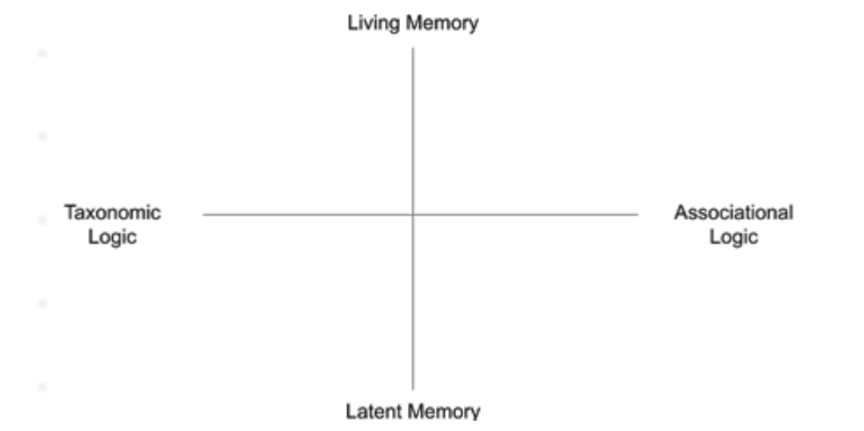
Latent Memory Refers to knowledge stored but not actively used. Exists in archives, databases, or written records. It is inactive until accessed or brought into practice.
Living Memory Knowledge that is actively transmitted and practised. Maintained through oral traditions, rituals, and cultural engagement. Keeps information dynamic and relevant in everyday life.
Taxonomic Memory Organises knowledge into structured, hierarchical categories. Examples: Encyclopaedias, scientific classifications. Emphasises order and standardisation for clarity and retrieval.
Associational Memory Links ideas through relationships, stories, or spatial metaphors. Examples: Songlines, memory boards, or thematic connections. Encourages flexible navigation and creative associations.
These four modes describe the different ways societies and individuals store, organise, and activate…
Highlights
id980095252
It’s well worth reading the whole article. This four-fold framework clarifies the tension I often feel between my note-making intentions and my note-making tools. Whereas the standard tools tend towards latent, taxonomic memory, I’m far more interested in living, associational memory. And until now I didn’t quite have the right words to express this.
id980096216
Every so often, my partner insists on reorganising our bookshelves in our living room. Apparently we have too any books, which is obviously not possible. Anyway this shuffling of the stacks drives me unreasonably crazy, makes me feel like I’ve undergone a lobotomy - and now, finally, I understand why: my extended mind has been messed up. My living, associational memory is undone, I’m being assailed by entropy.
Muy buen ejemplo de mente extendida.